
Investor of the Month: Sara Kindberg Adelskov on why product beats pitch
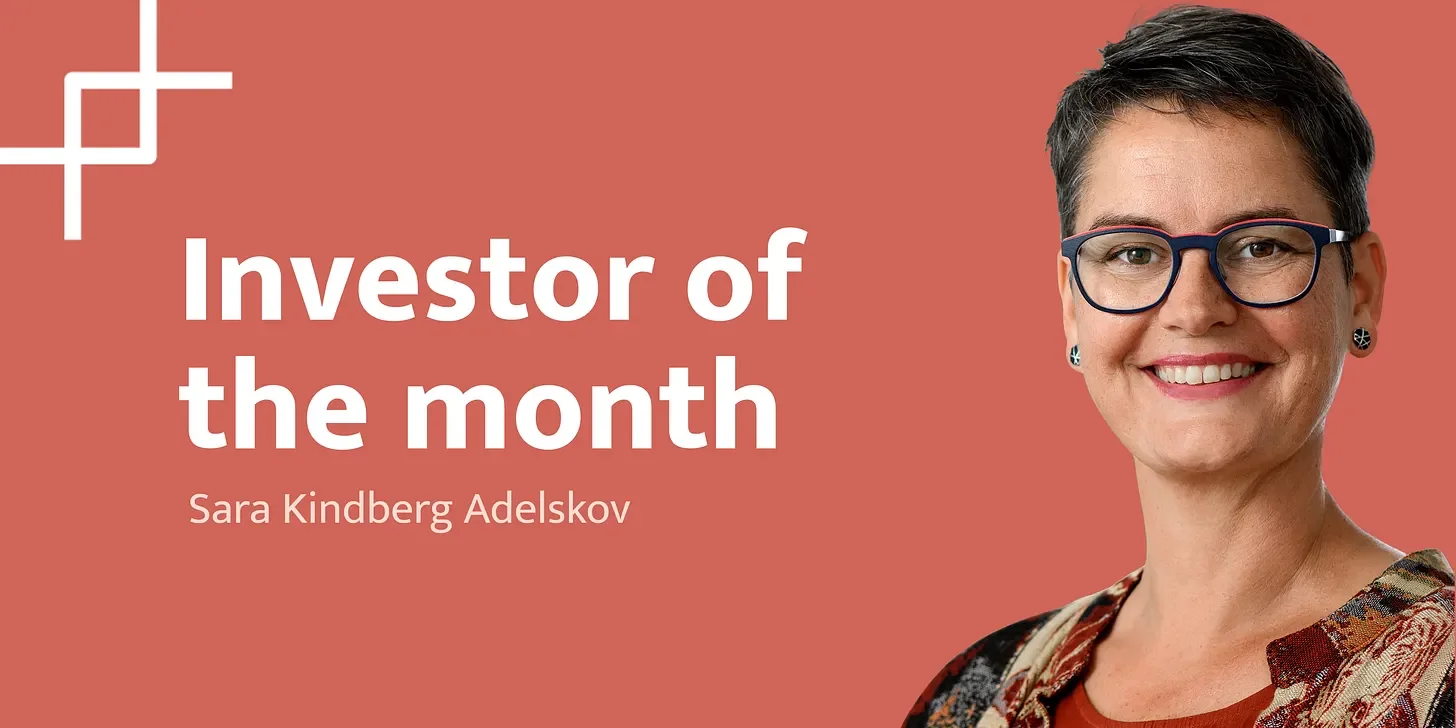
New month, new investor - and this time, we’re shining the spotlight on Sara Kindberg Adelskov.
New month, new investor - and this time, we’re shining the spotlight on Sara Kindberg Adelskov.
With a background in midwifery, a PhD in women’s health, and strong expertise in vaginal and pelvic health, Sara brings a rare mix of clinical insight, hands-on experience, and a clear point of view to the companies she backs. Through Angella Invest and her network, she supports founders who are not just building products - but challenging how women’s health has been built, treated, and prioritised
Some investors are drawn to polished decks, engaging pitches, clear market maps, and predictable growth curves.
Sara Kindberg Adelskov is not one of them. For her, everything comes down to one question: does the product actually improve women’s health? Everything else comes second.
In our conversation, she shares why she invests in women’s health, what she looks for in founders, and why commercial thinking matters just as much as a strong idea.
Why women’s health
Currently running two companies, GynZone and Vulva Enterprise, Sara has limited time - so when she chooses to invest, it is not just about business potential. It is about making a real difference.
When asked why she invests specifically in women’s health, her answer is simple:
“I care about women’s health. Not because men’s health does not matter - but because it is already funded. What matters to me is that women have a good quality of life. And that is still being overlooked.”
Sara invests alongside other women through Angella Invest, where she helps assess the clinical and professional strength of each case. With a background in midwifery and a PhD in women’s health, she specialises in vaginal and pelvic health - making her a trusted advisor within her network.
For her, women’s health is not a niche. It is one of the most overlooked opportunities in healthcare.
Sara is also clear about her own starting point. She does not come from money - and that shapes how she invests.
“Roughly one out of ten investments succeeds,” she says. “I do not know if I can beat that statistic, but I am ambitious, I work hard, and I surround myself with talented people.”
Not your traditional investor
Sara is not looking for safe bets.
“It has to be crazy,” she says. “If I invest, it has to fundamentally rethink how we approach a problem.”
For her, small improvements are not enough. It has to be bold. It has to be new. And it has to work.
At the same time, she is not just investing in ideas. She is investing in whether they can actually make it into the market.
“I care about whether it can actually be sold. Is there a customer in the end?”
That is also why personal relevance plays a role.
“People invest in what they relate to,” she explains. In her own company, GynZone, several investors joined because of their personal experiences with childbirth injuries.
But for Sara, personal relevance is not enough on its own. The product has to hold up.
That is also what draws her to companies like UVISA Health. The founder came across research showing that light could eliminate bacteria in oral tissue - and asked: why not apply the same principle to vaginal infections?
“That’s interesting to me,” Sara says, “because if it works, we can cut back on antibiotics.”
A simple idea - but one that could fundamentally change how recurring infections are treated and improve quality of life for millions of women.
Impact over safe bets
For Sara, investing is not just about returns. It is about backing ideas that make a real difference.
“I would rather invest where I know it helps people with challenges I have personally experienced - and that could have been avoided.”
She focuses particularly on vaginal health - an area she sees as both underfunded and under-innovated, despite being central to many women’s quality of life.
The opportunity, however, is clear.
“Women will pay for solutions that improve their quality of life,” she says. “The problem is not demand - it is the lack of good products.”
That is the gap she keeps coming back to:
not a lack of need - but a lack of products that actually work.
And she is selective.
“I do not invest in yet another device to solve a known problem if there is already a similar product on the market.”
What she wants to see from founders
A bold idea is not enough - and neither is a great pitch.
If the product does not work, nothing else matters.
According to Sara, many founders spend too much time building projections and polishing their vision - and too little time thinking about how the product will actually reach the market.
“I care about whether you understand how to sell the product. Distribution and partnerships matter much more than hypothetical revenue.”
What she looks for is founders who can balance both:
A transformative idea - and a clear path to market.
Pitching smart: stand out and stay the course
Sara also offers a reality check for early-stage founders:
“You should expect to do 100 pitches before securing funding.”
Investors have different perspectives, motivations, and thresholds for risk. Rejection is part of the process - because what works for one investor does not necessarily work for another.
But where many founders go wrong, according to Sara, is not persistence - it is focus.
Too many founders burn money on everything around the product - strategy, websites, all the bells and whistles - before they have a product that actually works.
Her advice is simple:
Build a minimum viable product early.
Get it into the hands of real users.
Learn fast.
Personality counts - a lot
Does personality matter?
“A lot,” she says. “Some people love strong female founders. Others do not.”
Too often, women are labelled as “too strong” - and penalised for it. Sara’s position is clear: “I personally love strong, opinionated founders.”
At the same time, she sees a common mistake. Many founders wait too long to seek guidance - and end up spending years trying to figure things out on their own.
Her advice: find people who have been on the journey before, ask for feedback early, and remember - you do not have to do everything yourself.
Finding investors like Sara
So where should founders start?
“Through structured networks,” she says.
“If you are working within women’s health, approach Angella Invest or similar groups. We have monthly sessions where startups pitch.”
Because while access can be difficult, the right networks still exist.
And knowing where to look can make all the difference.
Final takeaway
Across the conversation, one thing is clear:
The bar is not a good idea.
It is a product that works.
And the courage to build something that actually changes something.
